
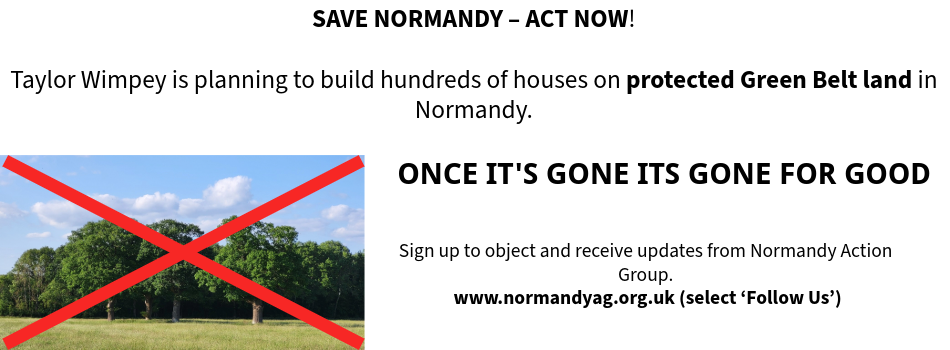
Our Normandy Village - Once its gone, its gone for good

Our Normandy Village - land near Pusseys Copse with Ancient Woodland

Our Normandy Village - view to the Surrey Hills National Landscape

Our Normandy Village - St Marks Church, Wyke, 15th c.

Follow us on




Protecting
Policy P8: Woodland, trees, hedgerows and irreplaceable habitats
The Council’s preferred approach is to have a policy that requires most developments to deliver a measurable BNG [Biodiversity Net Gain]. This is set out below.
Preferred option for biodiversity net gainThe aim is to provide clarity and detail for the requirement for developments to aim to achieve biodiversity net gain set out in policy ID4 through a policy that: 1) Clarifies that net gain means a minimum gain of 20 per cent. Major developments are required to follow Defra’s net gain calculation methodology ‘Defra Biodiversity Metric 2.0’ and submit a completed spreadsheet with the planning application. Minor developments are required to follow the simplified version of the metric. 2) Clarifies that biodiversity net gain is required on all sites except previously developed sites, unless the previously developed sites support at least one protected or priority species population or habitat, or an assemblage of species with an otherwise demonstrably high biodiversity value 3) Clarifies that proposals for net gain should be delivered in a manner that is consistent with policies P6 and ID4 so that measures are focused on local priorities and will provide best value. 4) Ensures development follows the mitigation hierarchy by: a) Avoiding impacts on biodiversity as far as possible. b) Where an impact cannot be avoided, the impact is minimised as far as possible. c) Where habitats are adversely impacted, they are restored or rehabilitated. d) Where impacted habitats cannot be wholly restored or rehabilitated, compensation measures are used, including off-site provision in the locality of the development line with the emerging national approach. 5) Requires new habitats delivered under biodiversity net gains to be secured and maintained for at least 30 years. 6) Where the applicant is unable to provide the gains on-site or off-site, the Council will seek a financial contribution to fund habitat measures if suitable land is available. 7) Supports applications for change of use in order to create biodiversity sites in appropriate locations, including biodiversity offsetting sites and sites within Local Nature Recovery Strategies. Justification for the choice of options and selection of preferred optionReasons the alternatives were selectedEvidence is available from Defra that shows that a BNG policy set at 10 or 20 per cent can be viable (subject to full plan viability testing). The only other reasonable alternative is to not have a BNG policy. Reasons for selecting the preferred option in light of the alternativesIt is not considered a reasonable option to not have a specific policy covering measurable BNG as this would not be in consistent with NPPF requirements for local plans. Adopting a BNG of 20 per cent is considered more reasonable than 10 per cent. At 10 per cent there is greater uncertainty over whether BNG will be achieved overall. The biodiversity decline is more serious in Surrey than nationally and, based on current evidence, the cost of increasing the BNG level from 10 to 20 per cent does not appear to be prohibitive. Adoption of the standard is subject to full plan viability testing. |
Question 8: Do you agree with the preferred option to address woodland, trees, hedgerows and irreplaceable habitats in Guildford?
Do you have any other comments or suggestions?
Response: Normandy Action Group disagree
Comments & Suggestions
NAG believes the distance provision in Policy P8: Woodland, trees, hedgerows and irreplaceable habitats, Preferred option for woodland, trees, hedgerows and irreplaceable habitats, 4 b) set at 15 metres is wholly inadequate. The policy makes no attempt to recognise the issue of wildlife disturbance and displacement during construction phase or post-construction.
Much of the Ancient Woodland stands in the west of the Borough support wildlife populations that benefit from isolation from human activity. Any development will drive away such populations and subsequent human occupation of surrounding developed land with associated activity, noise, air pollution and pet population will make it impossible for their return. The concept of 'net gain' cannot address such species dislocation.
To address development that is likely to have major impact on biodiverstiy and wildlife populations that 'net gain' will not address, we propose (text subject to change in bold italic):
Preferred Option 4(b) Replace “minimum 15 metres” with “minimum 50 metres”.
Preferred Option 4(c) Remove "road" as a separation option
Preferred Option 5 Remove "wherever possible"