
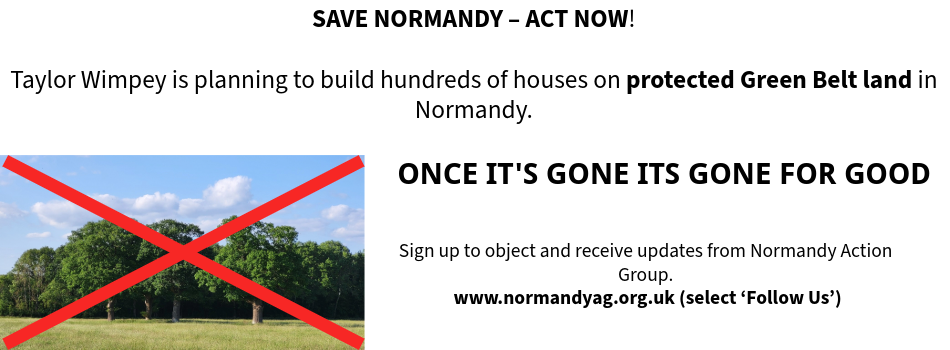
Our Normandy Village - Once its gone, its gone for good

Our Normandy Village - land near Pusseys Copse with Ancient Woodland

Our Normandy Village - view to the Surrey Hills National Landscape

Our Normandy Village - St Marks Church, Wyke, 15th c.

Follow us on




Protecting
Policy P6: Biodiversity in new developments
The Council’s preferred approach is to include a policy that sets out that biodiversity should be prioritised in development and that opportunities should be taken to maximise biodiversity gains while existing biodiversity features are retained. This is set out below.
Preferred option for biodiversity in new developmentsThe aim of this policy is to maximise biodiversity gains in all new developments, (including those exempt from biodiversity net gains - see policy P7), by having a policy that: 1) Requires new developments to prioritise biodiversity in their proposals as a general principle. 2) Requires developments within or adjacent to a BOA to support the achievement of the objectives of the BOA as set out in the relevant BOA Policy Statement44 and requires them to protect the designated and priority habitats and species in the BOA and improve habitat connectivity across the BOA. 3) Expects proposals to be guided by other national, regional and local biodiversity strategies. The Green and Blue Infrastructure SPD will signpost and map the relevant strategies to help inform planning proposals. Planting schemes and landscaping4) Requires proposals to maximise biodiversity gain in planting and landscaping schemes by choosing species, habitats and management regimes that provide best biodiversity benefit as set out in BOA policy statements and other strategies. 5) Tree canopies are expected to be retained and new tree planting is expected to focus on the creation of new connected tree canopies or the extension of existing canopies. Tree planting schemes should provide resilience in terms of climate, disease and ageing, planting large species with long lifespans where opportunities arise. It is expected that UK sourced native species will be used, unless imported strains would offer greater resilience. Measures on building structures6) Requires schemes to include features in or on building structures that support wildlife wherever possible, including integrated nesting boxes and green roofs and walls that will last for the lifetime of the development and cater for appropriate species and habitats. Site design7) Expects schemes to take opportunities to create new areas of habitat and provide appropriate links between existing habitats, avoiding and reversing fragmentation and species isolation. Built features are expected to be permeable for wildlife. Where invasive species are present, site design should not facilitate their spread. 8) Expects major schemes to include measures that encourage a sense of community ownership of green spaces. Sites that include or are adjacent to sensitive habitats9) Where sites contain or are adjacent to sensitive habitats, appropriate buffers and, where necessary, barriers should be incorporated in order to protect the habitats from the impacts of the development, including those resulting from recreational use. Schemes should be designed to avoid light pollution. If a lighting strategy is provided, it should take account of the potential impacts on wildlife. 10) Development that contains or is adjacent to a watercourse should retain or provide an appropriate buffer between built development (including parking areas, private gardens and landscaping) and the watercourse, composed of natural or semi-natural habitat. Justification for the choice of options and selection of preferred optionReasons the alternatives were selected‘No policy’ is the only reasonable alternative as no further options were identified. Reasons for selecting the preferred option in light of the alternativesThe national approach to biodiversity changed with the update to the NPPF in 2018 and biodiversity has been given elevated prominence. This, combined with the national focus on biodiversity, means that policy is needed to place a higher priority on biodiversity in development. Whilst biodiversity could be prioritised through policy P7, which mandates biodiversity net gains on all qualifying developments, and policy ID4 includes a strategic approach to biodiversity, neither of these policies provide enough detail o adequately shape development so that it preserves and enhances biodiversity. |
Question 6: Do you agree with the preferred option to address biodiversity net gain in Guildford?
Do you have any other comments or suggestions?.
Response: Normandy Action Group disagree
Comments & Suggestions
The settlements of Normandy and Flexford are now inset within existing Green Belt land. The Green Belt land surrounding the settlements contains recognised stands of Ancient Woodland (e.g. Pusseys Copse, Waldens Copse, Claygate Copse, Kiln Copse, Withybed Copse, Great Westwood, Catherine Frith all listed on DEFRA MAGIC mapping system), a designation that is now recognised in the NPPF, (as well as local SNCIs, i.e. Normandy Common, Wyke School Wood, Henley Park Fields, Withybed Copse are all identified by SyNP as parts of Surrey BOA TBH04). There is now a greater understanding that Ancient Woodland makes a significant contribution to biodiversity.
We believe the existing policy fails to address the following requirement of the NPPF:
NPPF Para 175 c) development resulting in the loss or deterioration of irreplaceable habitats (such as ancient woodland and ancient or veteran trees) should be refused, unless there are wholly exceptional reasons and a suitable compensation strategy exists
We propose in Policy P6 Preferred option for biodiversity in new developments, para 1) additional wording as follows in order for the policy to conform to NPPF 175(c) (text for insertion in bold italic):
"1) Requires new developments to prioritise biodiversity in their proposals as a general principle and protect existing irreplaceable habitats (such as ancient woodland and ancient or veteran trees)"