
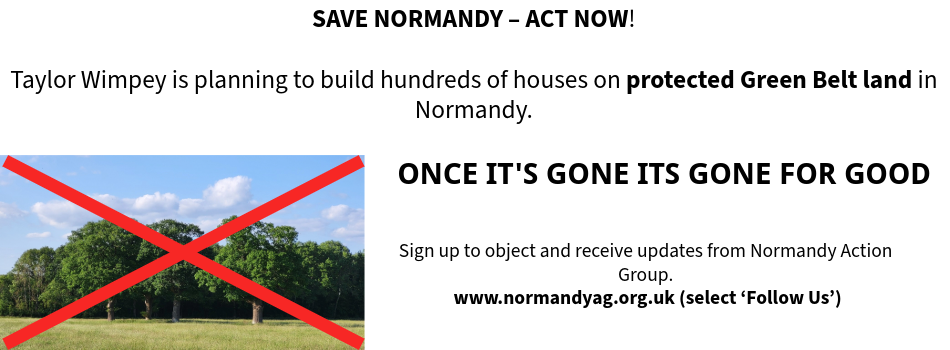
Our Normandy Village - Once its gone, its gone for good

Our Normandy Village - land near Pusseys Copse with Ancient Woodland

Our Normandy Village - view to the Surrey Hills National Landscape

Our Normandy Village - St Marks Church, Wyke, 15th c.

Follow us on




Economy
Policy E10: Rural development (including agricultural diversification)
Preferred option to support development of rural economyThe preferred option is to support the development of the rural economy by means of a policy that clarifies the types of new buildings or changes of use of buildings and land that the Council would consider acceptable in principle, subject to any proposal falling within the exceptions listed in paragraph 145 (a) to (g) of the NPPF for sites in the Green Belt, or meeting the requirement of policy P3 (1) of the Local Plan: Strategy and Sites18 for non-Green Belt sites. Green BeltWithin the Green Belt, the policy might support the following proposed forms of rural development, provided that any proposal falls within the exceptions listed in paragraphs 145 and 146 of the NPPF: 1) New appropriate facilities for small-scale outdoor sport or outdoor recreation, such as a sports pavilion or clubhouse, or a small-scale building within a farm holding to accommodate outdoor recreational facilities such as an animal petting area. 2) Conversion of vacant or redundant agricultural buildings to small-scale business, or recreational uses. CountrysideWithin the area of countryside, as designated on the Policies Map, the policy could support development of the following new uses in principle, provided they respect the area’s local character: 1) Farm shops (provided they support the farm’s agricultural operations and are operated as part of the farm holding) 2) Other farm diversification proposals, for example activity centres and arts and craft shops 3) tourist accommodation 4) small-scale rural tourism attractions 5) Small-scale leisure facilities 6) Horticultural nurseries and other small-scale business enterprises New buildings in the countryside should be clustered together where possible to reduce their visual impact on the character of the countryside and any built features should avoid harm to the local environment or residential amenity (particularly through noise). Non-agricultural uses within farm holdingsNew buildings, or proposed changes of use of existing buildings, within a farm holding that are to be used for non-agricultural uses will be required to be operated as part of the farm holding and support the farm’s agricultural operation. The Council will require adequate space to be made available within the curtilage of any building within a farm holding proposed for a farm shop or other non-agricultural use to allow for staff and visitor parking without detriment to the visual amenity of the countryside. If permission is granted for a farm shop, the Council may apply conditions to limit the overall scale of the development and require that any goods for sale that are not produced locally remain ancillary to the sale of local produce. Justification for the choice of options and selection of preferred optionReasons the alternatives were selected'No policy’ is the only reasonable alternative as no further options were identified. Reasons for selecting the preferred option in light of the alternativesWhilst policy RE9 of the 2003 Local Plan was superseded entirely by the NPPF in paragraphs 89, 145, and 146 (d), and by the adopted LPSS (2019) in policies P2, P3, E7, E8, E9 and D1, points 1 and 5 of Policy RE8 were not addressed and remain relevant. It was therefore considered the appropriate option to introduce a new development management policy to address these remaining points of Policy RE8. This option would also enable the introduction of new policy wording to explicitly support particular types of rural development that are compliant with the NPPF. |
Question 4: Do you agree with the preferred option to address rural development in Guildford?
Do you have any other comments or suggestions?
Response: Normandy Action Group disagree
Comments & Suggestions
As part of the development plan there will be significant housing growth whose impacts will be felt most acutely in the rural areas of the borough where there are planning constraints such as Green Belt, Surrey Hills Area of Outstanding Natural Beauty [AONB]and/or GBC designated Areas of Great Landscape Value [AGLV] amongst other constraints. In our local context, most importantly to Flexford, that has open views of the Hogs Back, the north slopes of which are contained within the adjacent AGLV area that is subject of consideration by Natural England for inclusion in Surrey Hills AONB.
NAG is concerned about ‘limited infilling’ in villages which is set out in part (e) of paragraph 145 in the NPPF. There is a significant lack of any definition for ‘limited infilling’ within the NPPF or guidance.
The Part 1 Local Plan sets out a definition of ‘limited infilling’ in paragraph 4.3.23 of the supporting text in relation to Policy P2: Green Belt as follows:
For the purposes of this policy, limited infilling is considered to be the development of a small gap in an otherwise continuous built-up frontage, or the small-scale redevelopment of existing properties within such a frontage. It also includes infilling of small gaps within built development. It should be appropriate to the scale of the locality and not have an adverse impact on the character of the countryside or the local environment.
NAG understands that local planning practice treats ‘limited infilling’ equivalent to the replacement of a single dwelling with two houses on the same site. Large bungalows in large plots are often the focus of such applications, of which there are a large number in the settlement of Flexford.
The approach advocated within Policy E10 does not allow for these impacts to be controlled or, where necessary, mitigated.
We propose that limited infilling is set out within a separate policy altogether for clarity. NAG proposes:
• A limit to the size of properties which can be built through infilling
• Infilling reflects the existing character and density of surrounding properties