
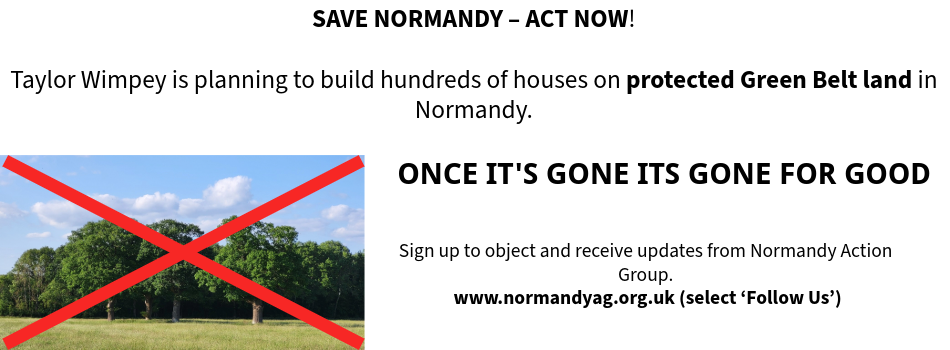
Our Normandy Village - Once its gone, its gone for good

Our Normandy Village - land near Pusseys Copse with Ancient Woodland

Our Normandy Village - view to the Surrey Hills National Landscape

Our Normandy Village - St Marks Church, Wyke, 15th c.

Follow us on




With 27 policies being proposed it is important to identify how each of these might apply to the Normandy/Flexford sites A46, A47 and A49 and A50. Once identified, their relevance can be examined and challenged where inappropriate.
SHMA is no justification
The Draft Plan’s proposed ‘growth’ is based on a document called the SHMA. The SHMA is the evidence base which GBC housing targets are based on. The report’s statistics are distorted by large student numbers from Guildford University and has disproportionately increased the ‘need’ for houses. The Office for National Statistics
(ONS) downgraded Guildford’s population growth. The confidential commercial model used to calculate the SHMA numbers cannot be checked (because GBC do not hold the model), it has been taken on trust, this is not satisfactory to some councillors. On the 24 May, some Councillors raised these concerns regarding the SHMA produced by G L Hearn, (the most critical piece of evidence in the Draft Local Plan) but the majority vote indicated that the full council meeting was satisfied that the SHMA was ‘a professional document’!
The Draft Plan proposes to build 693 homes per year, a total of 13,860 homes
The National Planning Policy Framework (NPPF) provides the opportunity to GBC apply constraints when calculating the overall housing target in the Borough (e.g. the Metropolitan Greenbelt, TBHSPA, Surrey Hills AONB, flooding, infrastructure) GBC has applied no constraints to reduce housing numbers whereas other Council’s in Surrey have chosen so to do. (Guildford Resident’s Association press release 7/6/2020 Legend Chart clearly illustrates the ‘unsustainable’ development proposed by GBC, in comparison to other council’s ‘sustainable’ housing targets of approx 300 homes per year.
Green Belt is being eroded by disproportionate ‘strategic sites’ without secure funding for infrastructure and road improvements, inset villages, insetting, the manipulation of boundaries, using rural exception sites outside settlement areas for the whole Borough rather than ‘needs’ of individual rural communities. Guildford and the surrounding village and countryside will be damaged irreparably. (Policies S2,H3,P6,D4).
NPPF 17 requires local authorities to ‘take account of the different roles and character of different areas, promoting the vitality of our main urban areas, protecting the greenbelts around them, recognising the intrinsic character and beauty of the countryside and supporting thriving communities within it’. GBC Draft Local Plan does not meet the requirement of (Policies S2,H3,P6,D4).
Are existing brownfield/retail sites being used wisely?
Only 2,742 homes are planned in Guildford Town Centre and urban areas. One third of jobs will be lost in the retail sector by 2020 according to The British Consortium,
because of increased internet shopping (13% of retail) and higher costs to retailers on the High Street. The recent closures of well known brands highlight a change in shopping habits.
Keith Meldrum of Guildford Residents Association stated in a press release June 2016, ‘Why do we need a 40% increase in retail space in the era of the internet when that land could be used for homes? Why are our politicians, who promised to protect Green Belt, offering up so much countryside for development and making so little
progress in better planning the town? Guildford Residents Association wants to see the following changes in the Local Plan, a realistic housing target that focuses on the needs of Guildford and takes full account of the constraints of being a congested gap town, a bus interchange which means you can travel easily in any direction from central point without needing a car...”Guildford’s green setting, tree lined approaches, fine view, historic centre and riverside maintained as valued and distinctive features of the town; a realistic housing target that focuses on the needs of Guildford, taking in full account of the constraints of being a congested gap town’.
Wasted and underutilised space
Park and rides take up lots of flat space. It has been argued that only one third of Onslow Village Park and Ride is utilised and questions have been asked whether the spaces are used by commuters travelling to London.
What is required and realistic?
The Housing and Planning Act 2016, means Local Authorities must have a register of brownfield land so sites can be recycled, regenerated and put back into use eg: Woodbridge Meadows, Walnut Tree Close by the station area and North Street. There is a desperate need for housing in central Guildford.
It would be more ‘sustainable’ to build homes in urban areas (brownfield sites have some or all services in place so it’s less expensive to develop).
To provide accommodation for 80 - 90% of university students on campus freeing up hundreds of homes in the town, instead of GBC’s proposed 60% of university students living on campus.
GBC own 30 acres of car parking accounts. By building more multi-storey car parks to reduce the amount of flat parking this could potentially release 8-9 acres of council owned land which could be developed for residential housing.
(Policies (B1-B8)There is a slow turnover of office space around the town centre and urban areas indicating a lack of demand. Long term redundant B1a offices could be changed to C3 residential properties (Government Guidance).
Avoid B8 (large warehouses and distribution centres) with low employment opportunities (due to the introduction of robotic technology) taking up acres of land.
(Policy E7)To avoid massive retail expansion in town centre as traditional retail falls, impacted by Internet retail. Developers have pulled out of North Street regeneration because it is not economically viable. It would be more sensible to have a smaller amount of retail, with more sustainable homes built in the town.
(Polices E2,E4) Surrey Research Park has permission granted to expand by 14% (not yet developed), GBC is proposing another expansion even though there is enough land to last the life of this Draft Plan (2015 Land and Assessment Need growth forecast is11.9%).
GBC should apply all constraints within the NPPF, to reduce the numbers of homes. GBC has planned for large urbanised ‘strategic sites’. It would be fairer and more ‘sustainable’ to work with Resident Associations, Parish Councils and residents and focus on the ‘need’ of the communties throughout Guildford Borough rather than focusing on ‘growth’, a decision wrongly taken by GBC planners.
By focusing on ‘need’ in communities would not overload the existing infrastructure, amenities and the road network. NPPF 1 provides a framework within which local people and their parish councils can produce their own distinctive local and neighbour plans reflecting their needs and priorities of their communities.
Building over our greatest assets
GBC’s pro develop Draft Plan extends to the countryside in our Borough (a concreted over landscape).
The rural areas around the Borough are highly valued by residents, dog walkers, visitors, ramblers, cyclists for leisure and competitions, and horse riders.
GBC acknowledges the importance of tourism and leisure within the Borough but again favours development over the protection of the Borough’s greatest asset the rural countryside and wildlife, The North Downs, Hog’s Back AONBs, LGVs, SPA, SSSIs and the THBSPA.