
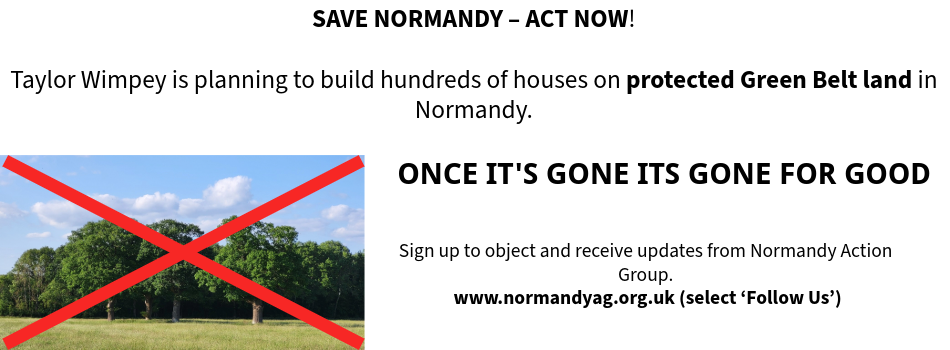
Our Normandy Village - Once its gone, its gone for good

Our Normandy Village - land near Pusseys Copse with Ancient Woodland

Our Normandy Village - view to the Surrey Hills National Landscape

Our Normandy Village - St Marks Church, Wyke, 15th c.

Follow us on




Policy D2: Sustainable design, construction and energy
|
Sustainable development Proposals for zero carbon development are strongly supported. Proposals for development, including refurbishment, conversion and extensions to existing buildings, must set out in a sustainability statement how they will deliver:
When meeting these requirements, the energy and waste hierarchies should be followed except where it can be demonstrated that greater sustainability can be achieved by utilising measures Climate Change Adaptation Developments should be fit for purpose and remain so into the future. Development proposals must set out in a sustainability statement how they have incorporated adaptations for a changing Renewable, low carbon and decentralised energy The development of low and zero carbon and decentralised energy, including (C)CHP distribution networks, is strongly supported and encouraged. All new developments must connect to (C)CHP distribution networks where they exist, or incorporate the necessary infrastructure for connection to future networks, unless it can be clearly demonstrated that doing so is not feasible or that utilising a different energy supply would be more sustainable. Proposals for development within heat priority areas as shown on the Policies Map and all sufficiently large or intensive developments must demonstrate that heating and cooling technologies have been selected in accordance with the following heating and cooling hierarchy unless it can be clearly demonstrated that an alternative approach would be more sustainable:
All (C)CHP must be of a scale and operated to maximise the potential for carbon reduction. Energy statements must be provided to demonstrate and quantify how development will comply with the energy requirements of this policy. Guildford Borough Council will work proactively with applicants on major developments to ensure these requirements can be met. Carbon reduction New buildings must achieve a reasonable reduction in the carbon emissions that remain after efficiency measures have been applied of at least 15 per cent. This should be achieved through the provision of appropriate on-site renewable and low carbon energy technologies. Proposals should set out how this will be achieved in an energy statement. |
Response: Object
The emphasis on energy and waste hierarchies and reduction of carbon emissions as part of building design are welcomed. However, the emphasis on CCHP (Combined Cooling Heating and Power) and communal heating networks seems curious – no such networks are currently locally available. There is an element of “Greenwashing” – the imposition of aspirational environmental targets while ignoring the simple fact that building dormitory towns is environmentally unsustainable. These all require increased car use and will lead to increased congestion and so air pollution and higher carbon dioxide emissions and a few solar panels on roofs will not compensate for the considerable environmental cost.