
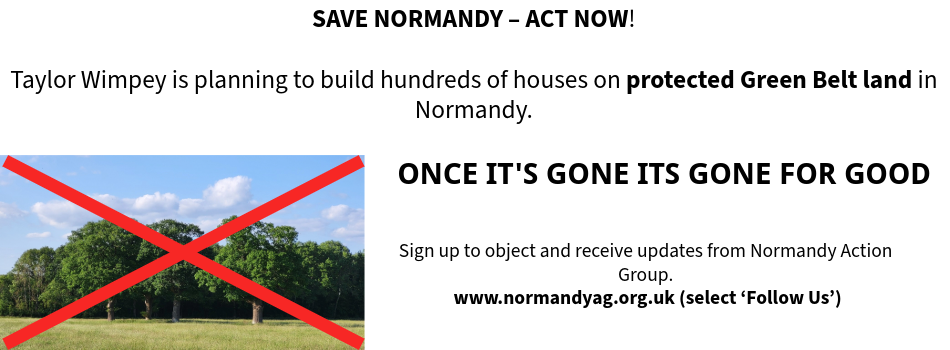
Our Normandy Village - Once its gone, its gone for good

Our Normandy Village - land near Pusseys Copse with Ancient Woodland

Our Normandy Village - view to the Surrey Hills National Landscape

Our Normandy Village - St Marks Church, Wyke, 15th c.

Follow us on




Economy
Policy E1: Meeting employment needs
|
The provision of 3,200 additional B class (see glossary) jobs to 2033 will be supported. In order to deliver these, land will be allocated for a net gain of between 37,000 and 47,000 sq m of floorspace for B1a and B1b uses and between 4.7 and 5.3ha land for B1c, B2 and B8 use class floor space to ensure an adequate supply of land is available for employment purposes. This will provide a range and choice of employment floor space over the plan period and accommodate the predicted future growth in economic development required for Guildford’s economy to develop and increase.
The Plan aims to ensure sustainable employment development patterns, promote smart growth (see glossary) and business competitiveness, and allow for flexibility to cater for the changing
B Class Uses The seventeen designated sites that together make up the borough’s current core supply of employment land will be protected as Strategic Employment Sites and changes of use from employment to non-employment uses resisted. The retention, intensification and employment based regeneration of these sites is encouraged. The Strategic Employment Sites are: Office (B1a) and Research & Development (B1b) Strategic Employment Sites
When developed, the new employment site at Gosden Hill Farm will be treated as a Strategic Employment Site. Industrial (B1c, B2 and B8) Strategic Employment Sites
When developed, the new employment site at Garlick’s Arch, Send Marsh/Burnt Common, will be treated as a Strategic Employment Site. Locally Significant Employment Sites The Locally Significant Employment Sites will be protected and within these sites changes of use to non-employment uses resisted. The retention and regeneration of these sites is encouraged and intensification where possible will be considered to be appropriate. The Locally Significant Employment Sites include all sites which meet the definitions set out below and include:
The Strategic Employment Sites and the Locally Significant Employment Sites are shown on the borough Policies Map. |
Response: Object
We object because
- the evidence base is unreliable
- there is unclear differentiation between B class uses
- only high added-value business uses are desirable, not low grade, low employment warehousing which is land hungry
- industrial and commercial businesses must be concentrated in the urban area, or existing business parks (eg Slyfield) not in the rural environment which the infrastructure is unable to support
- the rural environment must support micro or high tech businesses, agricultural industries, and tourism, and these sectors must not be damaged by general industrial development which is inappropriate